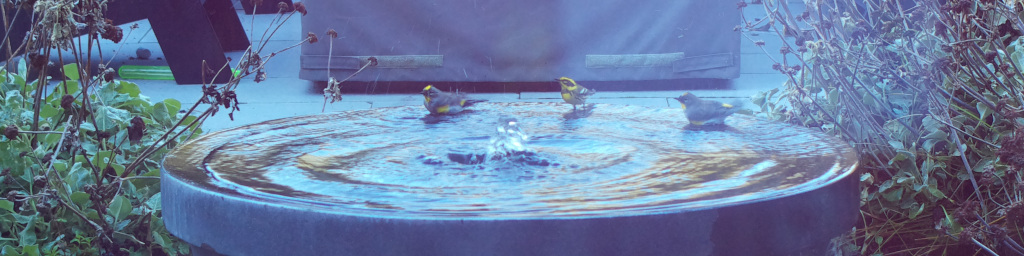

Fountain camera
I first dabbled in bird photography more than a decade ago, with the Paparazzi birdfeeder. This is my most recent effort, from 2026, lighter on the hardware but heavier on the software.
My garden has a fountain that’s often visited by birds that drink or bathe
there. I was curious what species visit me and when, so I set up a Raspberry Pi
with a
High Quality Camera module
and a
16 mm telephoto lens.
The Pi just takes pictures, one every 5 minutes, and uploads them to a GCS
bucket. From there, a Cloud Run job runs a bird detector (currently a D-FINE XL
trained on Objects365, ustc-community/dfine-xlarge-obj365) and a classifier
(EVA-02 Large fine-tuned on iNaturalist 2021,
timm/eva02_large_patch14_clip_336.merged2b_ft_inat21). I save the crops of any
detected birds, and display them on
https://fountain.tpudlik.com.
Some reflections on this project:
-
Thanks to a lot of help from Claude, I put it together in about a month of occasional evening hacking, which is a really astonishing pace. It clocks in at over 17,000 lines of Go and Python, including fun little touches like a custom labeling tool for the photos, and some surprisingly gnarly data wrangling, like reconciling iNaturalist species names (used by the classifier) with those from eBird species lists (used to restrict the IDs to birds that can actually be seen where I live). Before 2026, a project like this would have easily taken a month of full-time work, even if I was an expert in all the relevant technologies, which I am not. I would not even have attempted a project of such scope—which is a big reason why I’ve done so few side projects since finishing graduate school!
-
When I first started working on the paparazzi birdfeeder, in North Carolina in 2013, just classifying the birds would have been a research project in Computer Science. Now I basically1 just used some off-the-shelf models. It’s not perfect, but mostly it works!
- If I was getting all the hardware from scratch, I would have probably splurged on a Raspberry Pi 5, and attempted to run at least detection locally. But I had an original (2012!) Model B at hand, and just used that. Unfortunately, the outdated CPU would have required compiling a lot of software from source, and it looked like maintaining even a 5 minute photo processing cadence could be a challenge, so I put all the processing in the cloud.
-
One exception is that cropping the photo to just the region containing the rim of the fountain (even smaller than what’s in the header image) helps a lot with recall. I’m tempted to add more cropping or masking to remove the false positives from the water jet in the fountain’s center. ↩